Risk Management vs GRC Platforms: Choosing the Right Approach
Understanding the difference between Enterprise Risk Management (ERM) and Governance, Risk and Compliance (GRC) platforms and choosing the right approach for your organisation’s maturity.
Do You Need Risk Management or GRC?
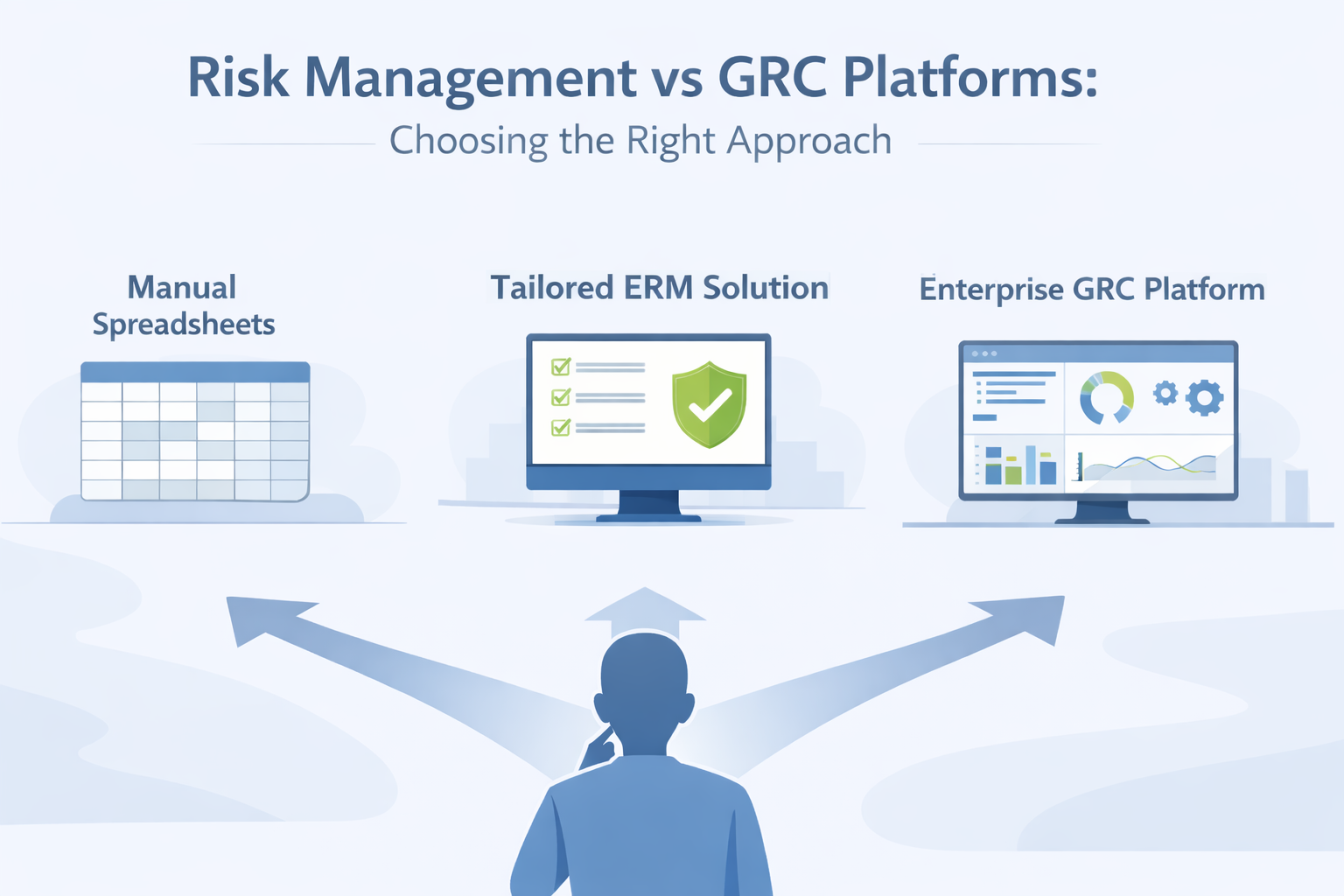
It depends on how complex your governance environment is. If your main goal is clearer visibility of organisational risk and better board oversight, structured enterprise risk management (ERM) is usually enough, and it is far quicker to put in place. A full GRC (governance, risk and compliance) platform earns its cost when you manage multiple regulatory frameworks, maintain large control libraries, run structured internal audit testing, or treat compliance reporting as a major function. Most organisations with simpler governance should strengthen risk management first and add GRC capability as that complexity grows.
As a rule of thumb:
You likely need structured enterprise risk management if:
- Your main goal is improving visibility of organisational risks
- Your board wants clearer risk oversight
- You want a central risk register
- Governance processes are relatively straightforward
You may need a full GRC platform if:
- You manage multiple regulatory frameworks
- You maintain complex control libraries
- Internal audit performs structured control testing
- Compliance reporting is a major organisational function
Organisations operating in simpler governance environments often benefit from strengthening enterprise risk management first, before introducing the additional layers of governance infrastructure that GRC platforms support.
Getting Clarity Between “Risk Management” and “GRC”
If you start researching risk management software, you’ll quickly encounter another term: GRC (Governance, Risk and Compliance).
At first glance, the two appear interchangeable. Many platforms present themselves as risk management systems, but when you look closer they are actually full GRC platforms, systems designed to manage governance processes, compliance obligations, internal audit activities, and risk in a single environment.
When we started building StartRisk, this distinction became obvious. Many organisations were being forced to choose between manual spreadsheet-based risk management or complex GRC platforms when what they really needed was structured enterprise risk management.
What is GRC Software?
Over the past decade, the GRC software category has grown rapidly, largely driven by increasing regulatory expectations and the need to manage complex control environments across industries such as banking, healthcare, financial services, and critical infrastructure.
Modern GRC platforms bring together multiple governance functions into a single system, typically including:
- Governance workflows and approvals
- Compliance framework management
- Control libraries and control testing
- Internal audit coordination
- Policy management and attestation
- Incident and issue management
- Risk registers and reporting
These platforms allow organisations to link risks, controls, policies, and regulatory obligations into a single governance environment.
In practice, a GRC platform becomes the operating system for organisational governance, helping organisations demonstrate compliance, coordinate assurance activities, and manage complex control environments.
Why Organisations Use GRC Platforms
For organisations operating in highly complex regulatory and control environments, this level of integration is often essential.
Some industries must manage overlapping regulatory frameworks, extensive control libraries, and formal assurance activities such as internal audit, regulatory reporting, and third-party assurance.
A global financial institution, for example, may need to track compliance across dozens of regulatory frameworks while coordinating risk, compliance, and audit teams across multiple regions.
In environments like this, GRC platforms provide the structure and traceability needed to manage governance at scale.
However, not every organisation operates within this level of governance complexity. For many organisations, the primary objective is far simpler:
They want to improve visibility of organisational risks and support better decision-making.
That goal aligns far more closely with Enterprise Risk Management (ERM) than a full GRC platform.
Why Many Organisations Struggle With GRC Platforms
GRC platforms are designed to support environments where governance activities are highly structured and interconnected.
These environments often involve:
- Multiple regulatory frameworks
- Large control libraries
- Formal control testing programs
- Internal audit coordination
- Dedicated governance, risk, and compliance teams
When those conditions exist, the integration provided by a GRC platform can deliver significant value.
However, many organisations operate with simpler governance models where these elements either do not exist or are relatively limited.
In these environments, organisations may find that enterprise GRC platforms introduce:
- Significant implementation projects
- Extensive configuration requirements
- Dedicated system administration
- Ongoing maintenance of complex control libraries
Some implementations take 3–6 months to deploy and significant budget to maintain, particularly where control frameworks and compliance obligations must be mapped across the system.
The result can be that governance becomes more about maintaining the system than managing the organisation’s real risks.
What Standalone Enterprise Risk Management Actually Means
Enterprise Risk Management (ERM) is a structured approach to identifying, assessing, and managing the risks that could affect an organisation’s objectives.
The most widely recognised global standard is ISO 31000, which defines risk management as a framework for improving decision-making, resilience, and organisational performance.
At a high level, effective ERM usually includes several core activities.
- Identifying Risks
- Assessing Risk
- Maintaining a Risk Register
- Assigning Risk Ownership
- Monitoring and Treating Risks
- Reporting to Leadership and the Board
ERM provides leadership and boards with structured visibility of organisational risk, helping them focus on the issues most likely to affect the achievement of strategy.
In short:
ERM is about better decision-making and organisational resilience.
The “Risk-First” Approach for Many Organisations
For organisations operating without extensive regulatory obligations or complex control environments, a more practical starting point is often a risk-first governance model.
This approach focuses on strengthening enterprise risk management as the foundation for governance, rather than attempting to implement the full complexity of a GRC platform from the outset.
Instead of starting with large governance systems, organisations benefit from first establishing a Minimum Viable Risk Framework. A minimum viable risk framework provides just enough structure to manage risk effectively without creating unnecessary complexity. It typically includes a small set of essential elements:
Clear Risk Ownership
Senior leaders are accountable for specific areas of risk, ensuring that risks are actively monitored and managed rather than simply documented.
A Simple Risk Identification and Assessment Process
Teams have a consistent way to describe and assess risks using clear language and shared criteria.
Structured Leadership and Board Visibility
Leadership and boards receive regular visibility of key risks, particularly those that sit outside the organisation’s risk appetite.
Practical Risk Discussions in Decision Making
Risk becomes part of everyday leadership conversations: embedded in project planning, strategy discussions, and operational reviews.
In many organisations, this minimum viable structure delivers most of the governance value required, without the implementation effort and administrative overhead of a full GRC platform.
If you’d like a deeper explanation of how this works in practice, you can read our guide to building a Minimum Viable Risk Framework.
When an Organisation Should Move From Risk Management to GRC
Over time, governance maturity and operational complexity often increase.
At some point, organisations may benefit from expanding beyond standalone risk management into full GRC capability.
Common indicators include:
- Increasing regulatory obligations
- Managing multiple compliance frameworks
- Formal control testing requirements
- Establishing an internal audit function
- Large or specialised governance, risk, or compliance teams
- Extensive control environments that require structured monitoring
The key insight is this:
GRC is often a later-stage governance capability, introduced when regulatory, assurance, and control complexity requires tighter integration across governance functions.
Understanding Your Organisation’s Risk Management Maturity
Most organisations progress through stages of governance maturity as their governance structures evolve.
Typical progression looks like this:
| Stage | Characteristics |
|---|---|
| Ad-hoc | Risks tracked informally or in spreadsheets |
| Emerging | Basic risk register and periodic reporting |
| Structured ERM | Defined framework, ownership, board reporting |
| Integrated Governance | Risk, compliance, and audit systems integrated |
Organisations operating within relatively simple regulatory environments often sit between Emerging and Structured ERM.
At this stage, the biggest opportunity is improving visibility, consistency, and ownership of risk.
If you’re unsure where your organisation sits, you can evaluate your maturity using the StartRisk Risk Management Maturity Self-Assessment Workbook, which helps identify practical next steps.
The Hidden Cost of Over-Engineering Governance
One of the most common governance mistakes is implementing systems that are more complex than the organisation’s current governance environment requires.
When governance becomes overly engineered, several problems emerge:
- Governance fatigue across teams
- Administrative overhead increases
- Risk registers become disconnected from strategy
- Compliance tasks crowd out real risk discussions
Effective governance should do the opposite.
Effective governance makes decision-making clearer, faster, and more informed.
A Practical Path Forward
When we started building StartRisk, we made a deliberate decision not to build another complex GRC platform.
We had seen too many organisations forced to choose between manual spreadsheets or systems designed for highly regulated industries — platforms that required dedicated compliance teams, months-long implementations, and significant ongoing administration.
For many organisations, the real need is simpler.
They need clear visibility of their risks, practical governance processes, and better decision-making support not layers of governance complexity.
That’s why we believe the most effective starting point for many organisations is a risk-first approach: building strong enterprise risk management foundations before introducing the additional structure of full GRC platforms.
StartRisk was designed specifically for organisations in this stage.
It provides a simple, modern risk management platform that helps organisations establish a minimum viable risk framework, improve risk visibility, and support better leadership and board decision-making without the cost, complexity, or implementation burden of traditional enterprise GRC systems.
If your organisation is looking to move beyond spreadsheets and build a practical, modern approach to risk management, you can try StartRisk today. Start now. Or if you want to talk with a StartRisk expert you can book a call here. Book now