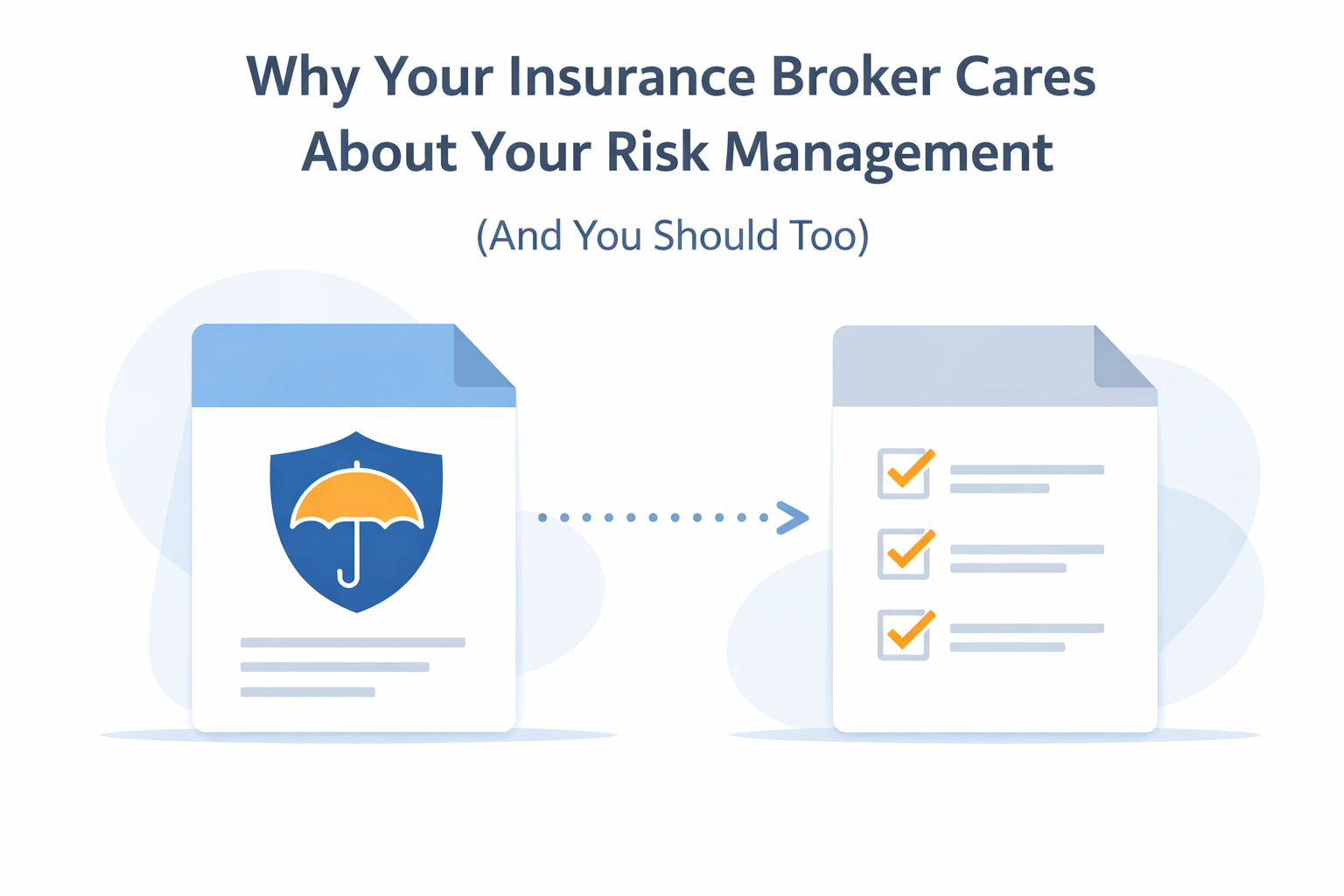
Why Your Insurance Broker Cares About Your Risk Management (And You Should Too)
Your premium isn't just about your claims history. It's about whether your insurer believes you know what you're doing.
Every year, around this time, I support a client with an insurance renewal process. The business gets their insurance premium notice, winces at the number, I call their broker, and ask: “Why did it go up again?”
The broker gives the usual explanation. Market hardening. Claims environment. Reinsurance costs. All true, none of it helpful.
But it got me thinking, there’s a part of the insurance process that rarely gets discussed, and it’s one of the few parts you can actually influence.
What Your Insurer Is Actually Looking At
When your broker goes to market for your renewal, they’re not just submitting a claim history and a prayer. They’re presenting a picture of your organisation. And the underwriter on the other end is asking one question: how well does this business understand and manage its risks?
That question gets answered through the proposal form, any supplementary questionnaires, and whatever your broker can tell the underwriter about how you operate.
If the answer is “they don’t really have a formal risk process, but they’ve been going fine for years” the underwriter prices in uncertainty. Uncertainty costs money.
If the answer is “they’ve got a documented risk framework, they review it regularly, and they can show you how they manage their key exposures” that’s a different conversation. Not because it guarantees lower premiums, but because it changes the underwriter’s perception of you from a blind bet to a calculated one.
The Trigger Nobody Talks About
I was recently speaking with an organiser of a small business conference, and one insight stuck with me. When we got onto the topic of risk management, they said one of the biggest drivers they see for small and growing businesses isn’t governance maturity or best practice — it’s insurance.
Not because founders suddenly become passionate about risk frameworks. Not because they’ve spent time reading about enterprise risk management. But because at some point, the insurance conversation forces the issue through price, whether cover is offered at all, or what exclusions get written into the policy.
They see it all the time. Businesses trying to secure cover, renew policies, or reduce rising premiums and realising that without some form of structured risk management, their options are limited. Better terms, broader coverage, even access to certain policies increasingly depends on being able to demonstrate that risks are understood and managed.
That insurance moment becomes the catalyst for something that, in reality, should have been in place much earlier.
Insurance Is Risk Transfer; Not Risk Removal
This is where most people get it wrong. Insurance doesn’t eliminate your risks. It transfers the financial consequence of specific events to someone else in exchange for a premium that reflects how likely they think those events are and how much they’ll cost.
So if you’re relying on insurance as your primary risk management strategy, you’re paying someone else to worry about things you should be managing yourself. And they’ll charge you accordingly.
Think about it from the insurer’s perspective. Two organisations in the same industry, similar size, similar claims history. One has a risk register, reviews it quarterly, can articulate their top five risks and what they’re doing about each one. The other has nothing… risks are managed informally, by gut feel, by whoever happens to be in the room when something goes wrong.
Which one would you charge more to insure?
And it’s not just insurers making that judgement. Clients, regulators, and funding bodies ask the same question in different ways: do you understand your risks, and are you managing them deliberately? Insurance is just one place where that judgement shows up clearly, but it’s happening everywhere.
What “Good Enough” Looks Like
You don’t need an enterprise risk management framework to change the insurance conversation. You need enough structure that your broker can credibly represent you as an organisation that takes risk seriously.
In practice, that means three things.
You can name your key risks. Not 50 of them. Five to ten. The ones that would actually hurt if they materialised. If you’re a community services organisation, that might be safeguarding incidents, funding dependency, key person risk, and regulatory compliance. If you’re a construction firm, it’s workplace safety, contract disputes, subcontractor reliability, and project delivery.
You can show what you’re doing about them. Each risk has at least one key control, something you’re actively doing to reduce the likelihood or impact. And someone is responsible for it. That’s the simplest version. Not a 30-page policy. A clear, honest picture of how you manage your most significant exposures.
You review it regularly. The review doesn’t need to be a formal event necessarily, it can be a 30-minute agenda item in a leadership meeting. The point is that your risk picture is current, not something you created two years ago and filed in a drawer.
If you can hand your broker a one-page summary of your key risks, current controls, and last review date, you’ve just given them something most of their other clients can’t provide. That’s a competitive advantage at renewal.
The Broker Relationship Changes Too
Here’s what I’ve seen happen when organisations get even basic risk management in place. The broker conversation shifts.
Instead of the annual “here’s your renewal, it went up, sorry” call, the broker starts engaging differently. They ask about specific risks. They suggest coverage adjustments based on what you’re actually managing versus what you’re transferring. They become an advisor, not just a transaction processor.
Good brokers want to work with clients who understand their own risks. It makes their job easier. It makes the submission to market stronger. And it usually means fewer surprises — for everyone.
Some brokers are now actively recommending that their clients formalise their risk management. Not because they’ve become governance enthusiasts, but because they’ve seen the market reward it. Sometimes that shows up as lower premiums. Often it shows up as broader coverage, fewer exclusions, or simply more competitive options in a tightening market. The evidence is there.
It’s Not Just About the Premium
The premium is the obvious motivator. But once you’ve built even a basic risk framework (partly because your broker nudged you into it) something else happens.
You start having better conversations internally. The Board starts asking about risk in a structured way, not just reacting when something goes wrong. The leadership team starts thinking about risk before making decisions, not after. Staff start flagging concerns because there’s actually somewhere for those concerns to go.
The insurance conversation was the trigger. But the value is in everything that comes after it.
That’s the part most people don’t expect. What starts as an insurance-driven exercise ends up changing how the organisation thinks, plans, and communicates. Risk stops being something you react to, and becomes something you factor into decisions upfront.
I’ve watched this play out dozens of times. The organisation that started with “our broker said we need this” ends up with a risk framework that genuinely changes how they operate. Not because they set out to become risk management experts, but because the basic discipline of identifying, assessing, and monitoring risks turns out to be useful. Who knew.
Where to Start
If you’re reading this because your renewal is coming up and your broker has started making noises about risk management — good. That’s a reasonable place to start.
Get your key risks documented. Assign ownership. Put a simple review cadence in place. Give your broker something to work with.
If you want help making that happen, this is the kind of problem we work through with organisations every week — from Board workshops to building risk frameworks that actually reflect how the business operates. The platform makes the ongoing management simple, but the real value is in getting the thinking right first. A conversation is usually the best place to start.
Mark Scales is the co-founder of StartRisk. He spent 20 years as a risk consultant watching organisations struggle with tools that were either too complex or too expensive, so he built something better.