Why Spreadsheets Can’t Deliver Risk
Why small businesses and NFPs outgrow spreadsheets long before they realise it.
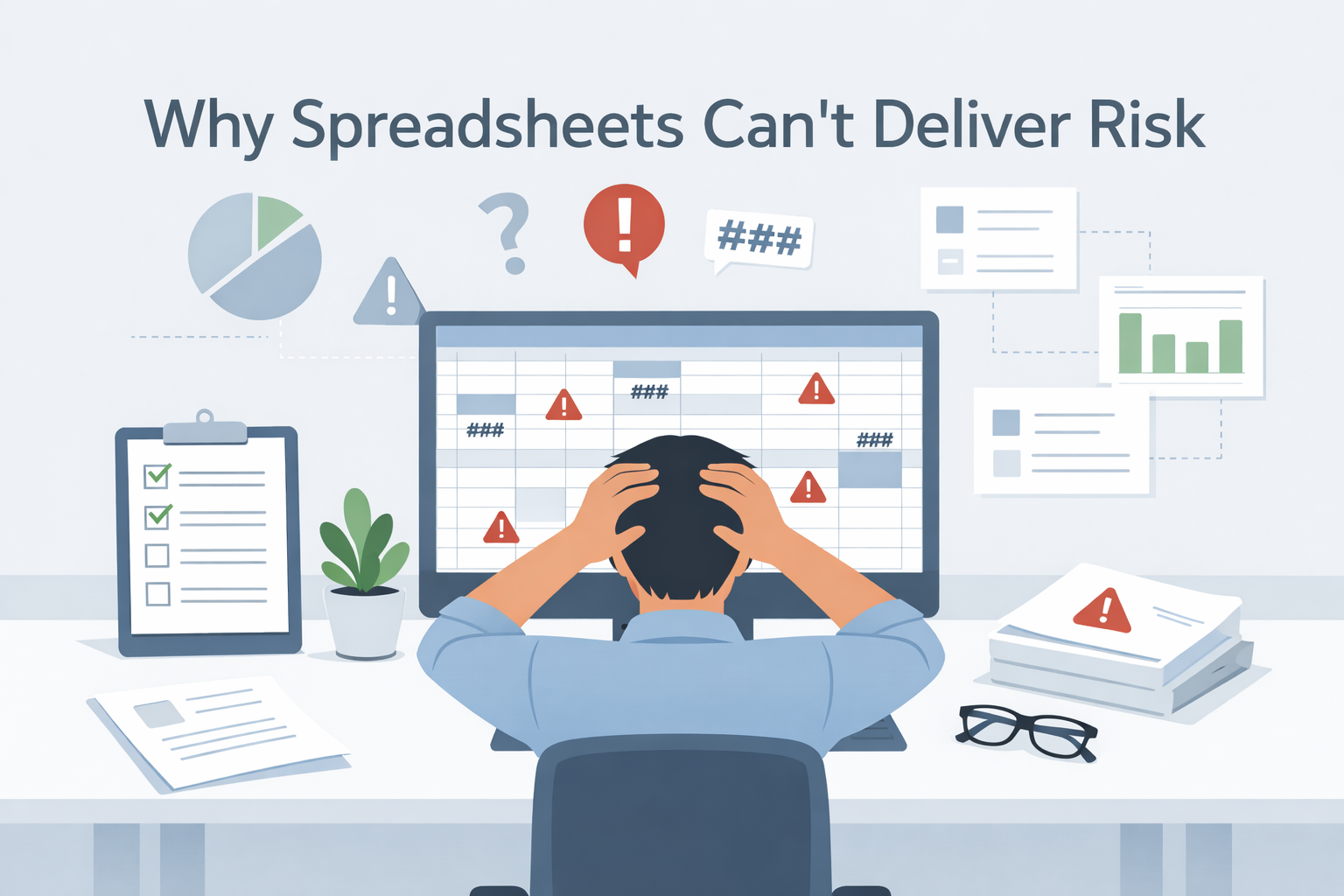
Most small and medium businesses (SMEs) and not-for-profits (NFPs) start their risk journey the same way: a spreadsheet. And at first, it makes sense, familiar, low cost, and seemingly “good enough.”
But as your organisation grows, expectations rise and reporting becomes more important, spreadsheets quietly turn into one of your biggest sources of inconsistency, confusion and hidden effort. The tool becomes the risk.
In this article, we break down why spreadsheets simply can’t deliver modern risk management — and what to use instead if you want to build confidence, clarity and consistency across your organisation.
The Problem: Spreadsheets Create More Noise Than Insight
For many organisations, risk management already feels like an administrative burden. When the entire process lives inside a spreadsheet, the pain multiplies.
Directors receive inconsistent reports. Executives waste time collating information. Staff avoid engaging with the process. And risk managers spend more time fixing formatting than improving capability.
Across all four StartRisk personas, the same themes appear again and again:
- inconsistent risk reporting,
- time spent chasing updates,
- version control issues,
- capability gaps,
- and no clear view of what truly sits outside appetite.
The spreadsheet is usually the common cause.
1. Reporting: Where Spreadsheets Fall Apart First
A spreadsheet gives you data. It doesn’t give you insight. And it certainly doesn’t give directors and executives what they need most: clarity, consistency and confidence.
Here’s the reporting reality when you rely on spreadsheets:
Inconsistent formats
Each manager structures risks differently. By the time the board sees it, the report looks more like a patchwork than a strategic view.
No automatic flagging or appetite alignment
If your organisation has a risk appetite (or is trying to implement one), spreadsheets can’t highlight exceptions or breaches automatically. Everything must be calculated manually.
Static information
Spreadsheets show a moment in time. They don’t track trends, changes, reviews or risk movements — all of which boards increasingly expect.
Laborious collation
Executives often spend hours copying and pasting content into board papers because there’s no single source of truth.
This is one of the universal pain points identified across all StartRisk personas: “growing expectations for more frequent, more accurate reporting” but tools that can’t keep up.
2. Usability: Spreadsheets Are Built for Analysts, Not Staff
Small organisations thrive when risk is a team sport — not something only one person can understand.
But spreadsheets work against this:
Hard to use for non-risk people
Most staff aren’t confident writing risks, identifying controls or using consequence scales. A spreadsheet gives them no guidance.
Easy to break, hard to fix
Formula errors, merged cells, hidden tabs — it only takes one accidental edit to undermine the whole tool.
No structure for good risk practice
There’s nothing to help people write clear event–cause–impact statements or assess risks consistently.
The Content Pillar Framework highlights this clearly:
- “Our staff all write risks differently.”
- “Our framework is too complex.”
- “We don’t know how to rate risks consistently.”
A spreadsheet gives no support to solve these problems.
3. Functionality: Spreadsheets Aren’t Risk Systems
A spreadsheet can store risks. It can’t manage them.
No workflows, reminders or ownership
You can assign an owner, but the sheet will never remind them.
You can set review dates, but nothing happens if they’re missed.
No linkages
Risk → controls → treatments → incidents → appetite → reporting
Modern risk management depends on these relationships. Spreadsheets can’t maintain them without complexity that soon becomes unmanageable.
No standardisation
Different teams rate the same risk differently.
Different versions circulate at the same time.
No two assessments look the same.
No automation
AI-generated risk statements, control suggestions, treatment plans or board-ready reports simply aren’t possible inside a spreadsheet.
This aligns strongly with the persona-level frustration: “Our risk register is just a spreadsheet with no intelligence.”
4. Time and Effort: The Hidden Cost Nobody Talks About
Most organisations underestimate the true time cost of running risk on spreadsheets.
Every update is manual
Reformatting tables, fixing broken formulas, updating ratings, recollecting information — none of this adds value, yet it consumes hours.
Reporting cycles are slow
Before every board meeting, someone assembles risk data from multiple tabs, files or teams. This is time executives should be spending on strategy.
High cognitive load
When the tool is clunky, staff avoid it — meaning risk managers (or the closest equivalent) are stuck doing everything themselves.
The Blueprint captures this pain perfectly:
Risk Managers feel “drowned in admin and not doing the strategic work they’re judged on.”
Spreadsheets keep organisations trapped in low-value, manual work.
5. Maintenance, Version Control and the Risk of Error
Every spreadsheet-based risk register eventually hits the same tipping point.
Version chaos
- risk_register_v6_FINAL2.xlsx
- risk_register_updated_August_use_this_one.xlsx
- risk_register_(James edits).xlsx
Directors lose confidence the moment they see two versions with different data.
Formula and structural errors
One broken cell can cascade into incorrect ratings, leading to flawed decisions or inaccurate reporting.
No audit trail
You can’t see who changed what, when, or why — a major gap for governance, accreditation or compliance.
A single point of failure
If the spreadsheet “owner” leaves, the organisation often loses knowledge with them.
In the Blueprint, this is explicitly listed as a common technology pain:
“Reliance on spreadsheets leading to version control issues and errors.”
6. Spreadsheets Keep Organisations at Low Risk Maturity
If your goal is to meet ISO31000 principles, satisfy funder expectations, or build governance confidence, spreadsheets will hold you back.
They make it difficult to embed risk in daily operations, restrict visibility, and prevent meaningful analysis. Every persona feels this:
- Directors don’t feel confident they’re “seeing the whole picture.”
- Executives feel risk work “interrupts core priorities.”
- Risk Managers struggle to maintain consistent standards.
- NFP Leaders can’t meet rising compliance expectations with the resources they have.
A spreadsheet simply can’t support the maturity organisations now need.
7. How to Know You’ve Outgrown Spreadsheets
If any of these apply, it’s time to move on:
- Reporting takes more than 30 minutes to prepare
- Staff avoid using the register
- Different teams record risks differently
- You have more than one version of the file
- Controls aren’t documented or reviewed consistently
- You can’t link risks to appetite
- Reviews don’t happen on time
- A single person “owns” the whole tool
- You can’t scale beyond a handful of risks
Small organisations don’t need complexity — they need clarity, consistency and a system that people actually use.
8. What Modern, AI-Enabled Risk Management Looks Like
Modern risk management tools don’t replace human judgement — they amplify it.
An AI-enabled platform can:
- Write clear, consistent risk statements
- Suggest controls and treatments based on best practice
- Standardise likelihood and consequence ratings
- Flag risks outside appetite instantly
- Build board-quality reports in minutes
- Maintain a single source of truth
- Reduce the administrative burden almost to zero
- Help small teams operate like they have a full risk function
This aligns to Pillar 3’s transformation from manual → automated and subjective → evidence-informed.
For SMEs and NFPs, this is the first time enterprise-grade capability has been accessible without the enterprise price tag.
A Better Way Forward
Spreadsheets will always have their place. But they are not, and have never been, a risk management system.
If you want consistent reporting, engaged staff, reduced admin, and a clear view of what matters, you need something designed to support modern appraoches to risk. Something that helps busy teams. Something intelligent.
That’s the future StartRisk is building: simple, powerful, AI-enabled risk management — accessible to every organisation, not just those with deep pockets.
If you’d like to see what modern risk management looks like, you can try StartRisk free at any time.