When Good People Become a Single Point of Failure
Understanding Key-Person Risk in Startups, SMEs & NFPs
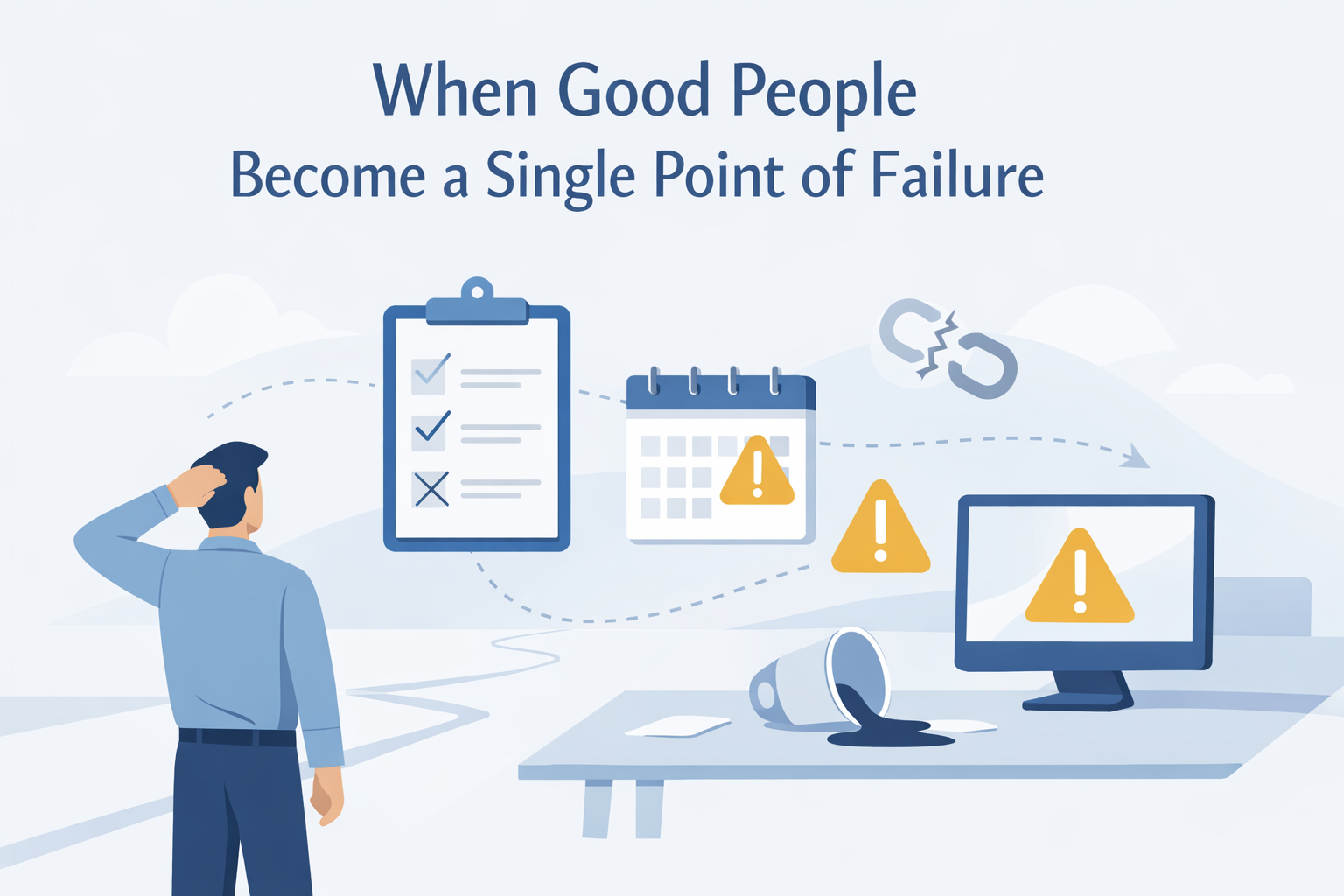
Key-person risk occurs when critical knowledge, decision-making, or relationships are concentrated in one individual, creating a single point of failure for the organisation.
In startups, SMEs, and not-for-profits, this risk is common and dangerous. If a key person becomes unavailable due to illness, resignation, burnout, or unexpected events, operations can stall, compliance can fail, and organisational momentum can collapse.
If you run or lead a startup, SME or NFP, you already know this truth: your people are the reason things work AND the reason they break.
Startups, SMEs and NFPs run lean by necessity. That’s often their strength. It also means key-person risk isn’t a sign of poor leadership… it’s a structural reality.
In other words: don’t beat yourself up for having key-person risk. But don’t ignore it either!
1. What Is Key-Person Risk in Startups, SMEs & NFPs?
Key-person risk is practically baked into the DNA of smaller organisations. With small teams, tight budgets, and a thousand competing demands, it’s inevitable that certain people become the “go-to” for critical work.
In fact, if you don’t have one or two indispensable heroes, you probably aren’t moving fast enough.
But here’s the catch: What starts as healthy ownership quietly morphs into organisational fragility.
I’ve seen this play out in countless audits.
You ask to speak with the person responsible for a topic - finance processes, contract management, payroll, operations. They’re outstanding. Deep expertise. Encyclopaedic knowledge. Every question answered with confidence.
Then you ask the follow-up:
“What happens if you’re hit by a bus?”
(Or, the more polite version: “What if you won the lottery and took a year off?”)
That’s usually when the room goes quiet - or there’s an awkward laugh.
Because knowledge living in one person’s head isn’t a control. It’s a risk.
This isn’t unusual. It’s the norm.
The goal isn’t to eliminate key-person risk (you can’t), but to make it manageable, visible, and fixable.
2. Common Examples of Key-Person Risk in Small Organisations
Key-person risk rarely looks like a “problem person”.
It usually looks like someone who cares too much, works too hard, or has impossibly high standards.
Here’s how it commonly manifests:
🚩 Institutional knowledge trapped inside someone’s head
A long-serving operations manager who “just knows” how the process works, who the stakeholders are, what the shortcuts are, and what to do when things go wrong.
Why this happens:
They want to be helpful. They love being relied on. It’s meaningful.
🚩 Shadow systems built by one person
The classic: a spreadsheet no one else wants to touch or a database only one staff member understands.
Why this happens:
They built it during a crunch period and never had the breathing room to document it properly.
🚩 Gatekeeping disguised as “protecting standards”
One clinical lead insisting that only they can review certain reports.
A program coordinator who insists no one is “ready yet” to engage with key stakeholders.
Why this happens:
Perfectionism. Pride. Fear of things going wrong. A strong desire to maintain control.
Often, imposter syndrome sits quietly underneath: “If someone else can do this, what does that mean about me?”
🚩 Single-threaded relationships with donors, suppliers, clients, or regulators
When one trusted staff member leaves, the relationship leaves with them.
Why this happens:
Relationship-building is emotional labour. It’s easier for one person to carry it and this can allow the organisation to cover more ground.
3. How Key-Person Risk Limits Growth and Scaling
Here’s the shift most leaders miss:
Key-person risk isn’t just a risk - it’s a cap on organisational leverage.
When one person holds too much:
- Leaders get stuck in operational noise
- Strategic projects wait for that one person to be free
- Every improvement requires permission or knowledge from the same human bottleneck
- Technology becomes underutilised
This is why some organisations never scale, not because of money or mission, but because their internal leverage is locked inside someone’s head.
The ROI of fixing key-person risk isn’t insurance. It’s:
- More capacity
- Faster decision-making
- Higher quality outputs
- Stronger culture
- Lower burnout
Or put simply: solving key-person risk multiplies your organisation’s potential.
4. Why Key-Person Risk Is Hard to Address (Human Factors)
This is where most leaders get stuck, because key-person risk feels personal.
You’re not just managing processes. You’re managing identity, loyalty, and pride.
Here’s the truth most leaders don’t acknowledge out loud, often:
- People become key-person risks because they care.
- They’re trying to protect quality.
- They’re trying to reduce pressure on others.
- They genuinely believe they’re helping.
And they are… until they’re not.
The leadership skill here isn’t technical, it’s relational. It’s the ability to gently say:
“You’re doing exceptional work.
But part of leading is making the system stronger than any one person, including you.”
This can feel counterintuitive for high performers who equate ownership with indispensability. Many fear that sharing knowledge or documenting processes will make them less valuable.
You can normalise the conversation by reframing the intent:
- Cross-skilling is leadership, not redundancy.
- Documentation is a legacy, not a threat.
- Process transparency protects the whole team, including them.
- AI and automation elevate their role — they don’t replace it.
The organisations that get this right treat key-person risk work as a shared responsibility, not a performance critique.
5. How to Reduce Key-Person Risk Without Bureaucracy
Here’s where smaller organisations often roll their eyes - they imagine heavy frameworks, endless policies, and new burdens.
That’s not the game. The game is Minimum Effective Resilience. The goal isn’t eliminating key-person risk — it’s reducing dependency to the point where the organisation can absorb disruption without panic, blame, or collapse.
Start small with critical workflows
Pick the top 3–5 “if this breaks, we’re in trouble” activities.
Document those first using:
- Short form videos (e.g. Loom or Tella)
- Shared folders
- Light-touch checklists
- Simple templates
- Basic process maps
You’re not trying to write an ISO manual. You’re capturing the 20% that delivers 80% of resilience.
Build a simple skills matrix
Not a huge spreadsheet, a one-page visibility tool that answers:
- Who can do what?
- Who’s the backup?
- Who’s trainable?
- Where are the single-person chokepoints?
Use this to create targeted cross-training plans.
Standardise recurring work
Replace manual workarounds with repeatable workflows, supported by:
- Automation
- AI-assisted procedures
- Standard templates
- Shared knowledge bases
This often leads to realising the hidden upside: The person who was the critical link finally gets to breathe.
Introduce modern succession thinking
Succession planning for SMEs and NFPs doesn’t need to look like corporate frameworks.
It’s simply:
- Identify the roles with heightended key person risk.
- Don’t wait for resignation to start training.
- Prepare people gradually, not in a crisis.
6. How AI and Technology Reduce Key-Person Dependency
This is where the conversation gets exciting because the solutions are now easier, faster, and cheaper than ever.
AI can help you:
- Document processes in minutes, not months
- Build onboarding tutorials with screen captures + explanations
- Create consistent templates and checklists
- Provide staff with instant access to organisational knowledge
- Automate routine decision-making
- Spot single-person dependencies before they become risks
The best part? This doesn’t replace people. It just stops the wheels falling off when life happens.
7. If You’re Wrestling With This, You’re Not Alone
Every Startup, SME and NFP leader I’ve worked with tells the same story:
“We know this is a problem." “We keep meaning to fix it, but our prior efforts haven’t landed.” "But we’re flat out and our key people are even busier.”
That’s normal. But it’s also the perfect time to start, before the pressure builds to breaking point.
Addressing key-person risk isn’t a sign of mistrust. It’s one of the greatest acts of leadership care you can offer your team.
It says, “I value you too much to let the whole organisation depend on you alone.”
Does this resonate?
Curious whether this feels familiar to others. Have you seen this kind of single-point dependency in your organisation?
And if it does resonate, I’m happy to offer a few short (20-minute) conversations to help leaders think through where this risk might be showing up. No pitch, just a practical governance discussion.
If you want to book a time, you can reach me at mark@startrisk.com.
FAQ: Key-Person Risk in Startups, SMEs & NFPs
What is key-person risk?
Key-person risk occurs when critical knowledge, decision-making authority, or relationships are concentrated in one individual, creating a single point of failure for the organisation. If that person becomes unavailable, operations, compliance, and continuity can be seriously disrupted.
⸻
Why is key-person risk so common in startups, SMEs and not-for-profits?
Smaller organisations run lean by design. With limited staff and resources, people naturally take on multiple roles and become indispensable. This is often a strength early on, but without intentional controls, it quietly becomes a structural risk as the organisation grows.
⸻
Is key-person risk always a bad thing?
No. Some level of key-person dependency is inevitable and even healthy in fast-moving organisations. The problem arises when the risk is invisible, unmanaged, or ignored — not when expertise exists, but when it’s undocumented and unsupported.
⸻
What are the early warning signs of key-person risk?
Common signs include undocumented processes, single-threaded stakeholder relationships, critical spreadsheets or systems owned by one person, and work that stalls when a particular individual is unavailable. If people say “only they know how that works”, key-person risk is already present.
⸻
How can organisations reduce key-person risk without adding bureaucracy?
Start small. Focus on documenting a handful of critical workflows, cross-skilling team members, standardising recurring tasks, and making knowledge visible. The goal is minimum effective structure — not heavy policies or enterprise frameworks.
⸻
How can AI help reduce key-person risk?
AI can rapidly document processes, create onboarding guides, standardise templates, and provide instant access to organisational knowledge. Used well, it reduces dependency on individual memory while freeing key people to focus on higher-value work.
⸻
Is addressing key-person risk a sign of mistrust in staff?
No — it’s a sign of leadership maturity. Managing key-person risk protects staff from burnout, reduces pressure on high performers, and strengthens the organisation as a whole. It says, “We value you enough to not make everything depend on you.”