How AI Reduces Human Bias in Risk Management (Without Removing Humans)
Why small businesses and not-for-profits rely on AI to create consistent, fair and defensible risk assessments.
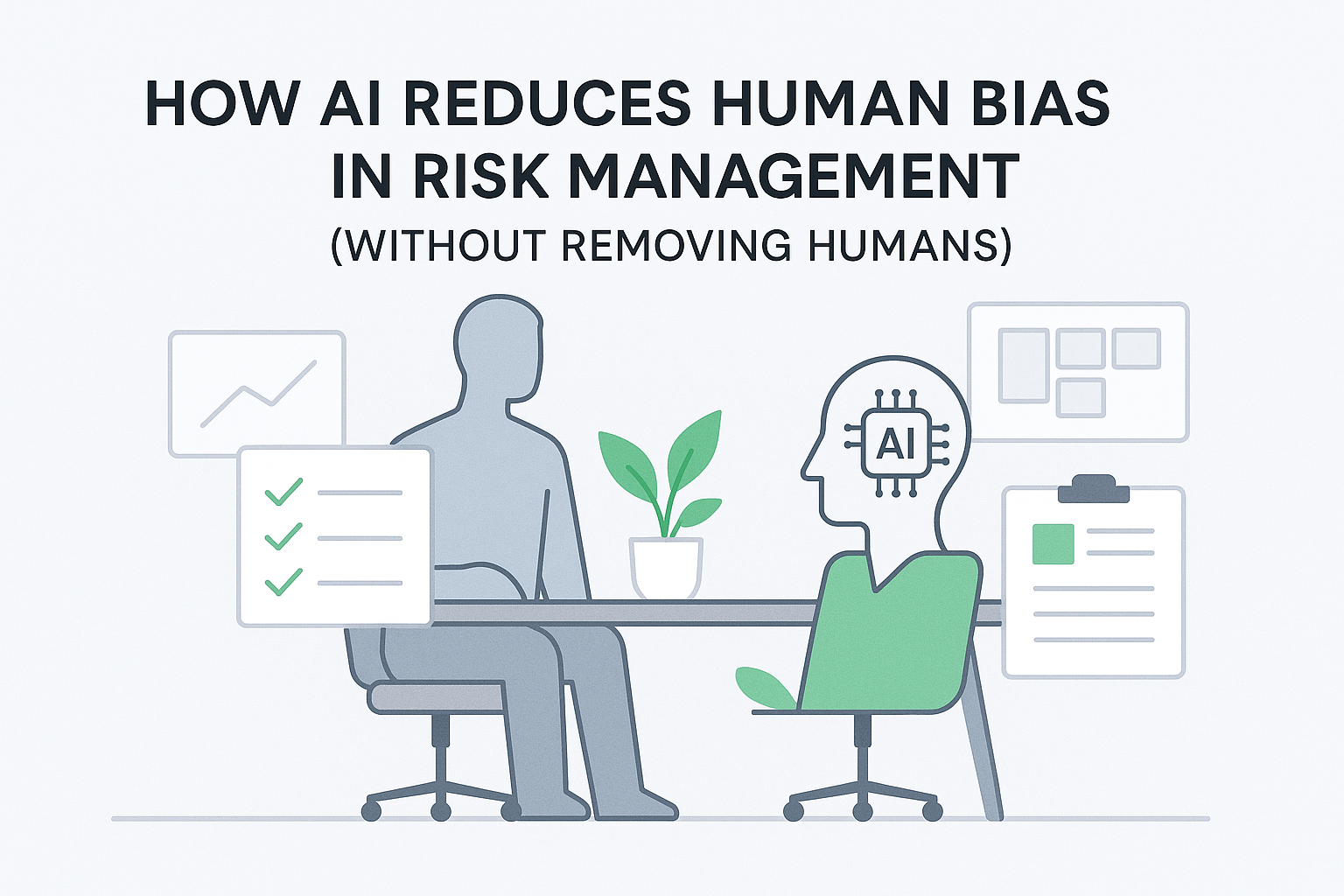
I wanted to explain how we at StartRisk are seeing AI help small and medium organisations and non-profits overcome the most persistent human problems in risk management - subjectivity, bias, personal experience, mood, confidence, inconsistency, and cognitive blind spots - while still keeping human judgement exactly where it belongs: firmly in the loop.
The Problem: Humans Don’t Experience Risk the Same Way
If you’ve ever tried running a risk workshop, you’ve seen this play out.
Put ten people in a room, give them the same likelihood and consequence matrix, present the same scenario, and you’ll get… ten different answers.
It’s not because people are careless or unprofessional. It’s because we are human. We interpret risk through personal history, psychology, lived experience, emotional state, and even what kind of morning we’ve had.
This variability is a superpower for creativity and decision-making - but it’s a nightmare for risk consistency.
Here are the patterns I’ve seen across hundreds of workshops:
- “Optimists” consistently downplay likelihood.
- “Catastrophisers” consistently rate everything as extreme.
- People with lived experience of an issue rate it higher.
- People who feel safe in a topic rate it lower.
- A single senior person can skew the entire room’s scoring.
Risk matrices were meant to standardise this. In practice, they highlight how differently humans think.
A Story I Used to Tell (And Still Love)
When I ran risk-framework implementation sessions, I used a simple exercise to show how subjective risk really is.
First, I’d display the Australian Government’s Thailand Travel Advisory:
“We continue to advise exercise a high degree of caution in Thailand. There’s an ongoing risk of terrorism… Popular tourist areas may be the target of attacks… Reconsider your need to travel to Yala, Pattani and Narathiwat provinces.”
Then I’d ask everyone to rate the risk on a 5×5 matrix anonymously.
The results were all over the place.
Some rated it Low:
“I go to Thailand every year. Never had an issue. Feels safe to me.”
Some rated it Extreme:
“Terrorism risk? I’d never go. Why would anyone?”
Same information. Same matrix. Same instructions. Completely different interpretations.
And that’s the point: humans don’t calculate risk, we feel it.
This is normal. It also creates real problems for many organisations, including:
- inconsistent ratings
- unclear prioritisation
- poor reporting
- frustration at board level
- decision-making based on individual perception instead of shared understanding
Where AI Helps: Removing the “Biological Noise”
Modern AI, used properly, doesn’t replace human judgement, it replaces inconsistency. AI gives us structure around human variability.
Think of AI as the world’s most consistent risk colleague. The one who:
- always uses the same criteria
- always interprets likelihood the same way
- always applies your appetite the same way
- never has a bias toward “optimism” or “paranoia”
- never gets tired, rushed, influenced or distracted
AI becomes the ground floor of a risk rating.
Humans provide the context, insight and decision-making.
Together they create a level of standardisation that has never been possible before.
Three Human Problems AI Fixes (Without Removing Humans)
1. Subjectivity in Likelihood
A person who has travelled frequently will perceive a travel warning differently from someone who has never left Australia.
AI doesn’t have a holiday history.
It evaluates likelihood using:
- recognised patterns
- historical data
- contextual cues
- semantic meaning
- organisational appetite settings
Humans then validate, adjust and refine, but the baseline is stable.
2. Inconsistent Interpretation of Consequence
Some people think reputational damage is the worst thing that can happen. Others focus entirely on safety, or financial loss, or customer impact.
AI evaluates consequence against your definitions every time. This removes the “pick your favourite consequence category” problem entirely and also ensures that all of your key risk classes get considered in every scenario.
3. Halo Effect, Seniority Bias and Anchoring
I’ve seen entire rooms shift their rating after one senior person speaks up. I remember one client in particular who’s CEO had a habit of speaking first and listening second, unsurprisingly what he heard was almost always an echo of what he had said in the first place.
AI doesn’t care about hierarchy.
It provides the same rating whether the CEO, the intern, or a consultant enters the information. This levels the playing field and protects decision-making from loud voices or confident personalities.
But Don’t Misinterpret This: Humans Are Still Essential
AI can:
- propose a rating
- point to appetite
- identify missing controls
- suggest treatments
- spot anomalies or patterns
- flag inconsistencies
But AI cannot (for the time being):
- understand organisational nuance
- judge political sensitivity
- understand local community dynamics
- weigh cultural factors
- consider the “real-world practicality” of a control
- sense organisational mood or pressure
That’s why the future of risk is human-in-the-loop AI and not AI instead of humans.
Humans bring wisdom, experience, organisational knowledge and empathy.
AI brings consistency, structure, recall and analytical horsepower.
Together you get:
better decisions, clearer prioritisation, and reporting boards can trust.
Try StartRisk
If you’d like to see what AI-enabled risk management looks like in practice, with consistent ratings, clearer reporting, and an AI assistant that works alongside your team, you can try StartRisk free.
It takes less than an hour to set up, and you’ll have a working, AI-supported risk register the same day.